

The Global Forum on Bioethics in Research (GFBR) will hold a two-day meeting on 17 & 18 November 2026 in Bangkok, focused on the topic: “Digital footprints and real-time data in the context of health research: ethical issues”, with particular attention to low- and middle-income country (LMIC) contexts.
A ‘digital footprint’ is the accumulation of information about an individual that is generated when they use the internet or connected devices e.g. through the use of smartphones, wearable devices, social media platforms, consumer purchases, or internet searches. The Forum will focus on the use of these types of data in health research. The Forum topic does not extend to digital health research more broadly. For example, a presentation proposal that focuses only on the use of electronic health records is out of scope. See below for further details on the topic.
This notice includes details on the following:
- ABOUT GFBR
- TOPIC SUMMARY
- CALL FOR PARTICIPANTS
- CALL FOR PRESENTERS
- KEY THEMES AND QUESTIONS
- DEADLINE
- AWARDS: DECISION MAKING AND ELIGIBILITY FOR FUNDING
- NOTIFICATION
- PRIVACY
Deadline for applications: Wednesday 27 May 2026 at 11.59pm CEST/Geneva.
If you have any questions about this call, please contact gfbr@who.int.
1. About GFBR
GFBR is a global platform for the exchange of experience and expertise on research ethics among researchers, policymakers, ethicists and other stakeholders. The Forum is intentionally small and emphasises interactive small group discussion, networking, and mentorship. The Forum prioritises the participation of colleagues from LMICs and creates a venue for open and inclusive discussions.
The Forum focuses on a different emergent topic each year. See below for details of this year’s topic and read the background paper and watch this video for details on the Forum scope.
For more information on GFBR visit: gfbr.global/about-the-gfbr
You can apply online as either a participant or presenter using the links below:
(NOTE: When you open the application form, check the header to ensure you are completing the correct form. Depending on the configuration of your browser, you may need to scroll up to see the explanatory notes at the beginning of the form.)
Traditionally, the Forum is built around real-life case study presentations that ensure discussion of the ethical issues is grounded in the practical realities of how research is conducted, particularly in low resource settings. This year GFBR is also inviting normative and conceptual papers, along with policy-related proposals. See section 4 for further details.
Places are awarded on a competitive basis and successful applicants from LMICs will receive an award to cover the cost of their travel, accommodation and single-entry visa. Attendees need to cover their own travel insurance costs.
The application forms will close automatically at the deadline so please ensure you have submitted your application in good time. Applications that are incomplete and/or not submitted by the deadline will not be considered. The application form does not allow you to save partial responses and return later. We recommend you prepare your written responses offline and copy them to the form when finalised.
Applications will be reviewed by the GFBR Planning Committee and selection will be made on the criteria listed below. Applicants are not limited to academic researchers; staff from government, non-governmental organisations, and private sector organisations are also encouraged to apply if their applications are focused on the topic.
If a presentation proposal is multi-author, and co-authors would like to attend, they must apply separately as participants and state the name of their co-author and title of the proposal in their application.
During GFBR, presenters from around the world will share their presentations and discuss cross-cutting issues, and then participants will discuss the challenges and questions raised in both plenary and small group discussion. The plenary and discussion sessions are conducted in English.
Provisional dates for the Forum are 17 & 18 November 2026. The provisional location is Bangkok, Thailand.
2. Topic
GFBR will focus on the ethical challenges around the collection and use of digital footprints in health research in LMICs. A ‘digital footprint’ is the accumulation of information that is generated through, for example, the use of smartphones, wearable devices, social media platforms, consumer purchases, or internet searches. Please read the Forum background paper for details on the topic and scope.
Forum topic summary: Digital footprints are the unique trail of data individuals create, either actively or passively, when using the internet or connected devices. Wearable devices, smartphones, social media platforms, consumer technologies, internet searches, and artificial intelligence prompts can generate vast quantities of data about individuals’ behaviours, movements, physiological states, and social interactions. As more data than ever is being collected about humans across multiple directly and indirectly health-related indicators and determinants, the boundaries of what constitutes ‘health data’ are both expanding and becoming blurred.
Digital footprints and real-time data are generally collected by non-health sectors, especially commercial entities, for other primary purposes. Nonetheless, these data may become health-relevant when linked with other variables or when hypothesised to be proxy indicators of health outcomes. They are increasingly leveraged in health-related research, where they have potential to enhance our ability to understand disease patterns, predict risk, monitor interventions, formulate nudge policies, and inform public health responses. However, these novel data sources may lead to new research approaches that raise distinct ethical and governance issues. The GFBR aims to map the current ethical debates and tensions around the collection and use of digital footprints and real-time data in health research, focusing on the context of low- and middle-income countries (LMICs).
Proponents see the potential for digital footprints and real-time data to transform health-related research in LMICs, whether by offering novel and more accessible approaches to data collection or by enabling data generation where other means of data collection (e.g., electronic health records) are unavailable or inoperable. Critics worry about representativeness and accuracy of these data, and question whether and how we might decide to promote real-time data gathering techniques over traditional approaches, and under what circumstances. These tensions highlight the importance of having a good understanding of the potential ethical challenges that may arise in the use of digital footprints and real-time data for health-related research, and that we have LMIC-centered approaches and frameworks for working through these challenges. Promoting scientifically sound and ethically robust research through sharing and using high-quality data is critical to maximising the potential benefits of health-related research and respecting relevant communities, citizens, and research participants.
GFBR encourages multidisciplinary discussions on how we can share and use data well in a complex, cross-sectoral setting that involves stakeholders who are not traditionally part of the health research ecosystems and research ethics oversight mechanisms (e.g., software developers, corporations). Recognising ongoing resource disparity and digital divides within and across regions that may have different health priorities, the GFBR meeting will identify existing use cases of digital footprints for health research, explore current ethics review models, identify unresolved ethical questions or stubborn problems, and propose governance solutions that are ethically justified, pragmatically operationalisable, and which may allow us to radically reimagine how we define and ethically approach the use of digital footprints and real-time data in health research.
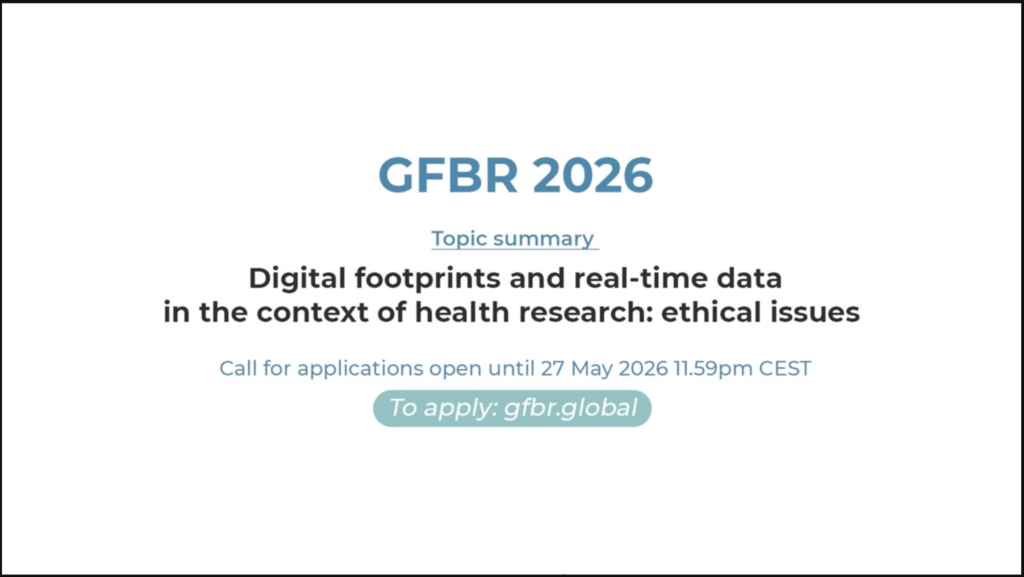
This video provides an overview of the GFBR 2026 topic. Speakers highlight key themes and questions addressed in the background paper.
3. Call for Participants
Who can attend GFBR?
Most participants are selected through a competitive process[1]. Up to 60 participants will be selected from those eligible who apply by the deadline. We are seeking broad geographical representation, a mix of disciplinary expertise including health researchers, clinicians, healthcare workers, bioethicists, policy-makers, health system functionaries, and lawyers, and a combination of people who are early in their careers and leaders in their fields. All participants are expected to actively take part in plenary and small group discussions and networking opportunities.
Accurate journalistic reporting is essential to ensure that the public are engaged and well informed about research. For that reason, GFBR will support the participation of up to three journalists from LMICs. The meeting will provide a unique opportunity for talented journalists to network with international experts and forge stronger connections between health researchers, ethicists, policy-makers and journalists. Funding support will be provided to LMIC based journalists only.
How to apply as a participant or journalist
Complete the online participant application form, which contains six sections:
- Data protection consent
- Your experience and motivation to attend GFBR
- Personal details (name, contact details etc.)
- Work and training (your current and past jobs etc.)
- Funding request
- Personal references
Journalists: Please provide details on the application form about:
- Your journalistic experience
- The ways in which you would disseminate the meeting outcomes in your local and regional context, including which media outlets you propose to use and the format of reporting.
This sample participant application form shows the information you’ll be asked to provide.
4. Call for Presenters
Types of presentation proposals
The GFBR organisers are looking for four types of presentation proposal. Proposals should focus on the ethical complexities of using digital footprints in health research i.e. the real-time data collected from people’s wearable devices, smartphones, social media platforms, consumer purchases, or internet searches. Proposals that do not address these types of data and that focus only on other types of data (e.g. electronic health records) are not in scope.
- Real-life case studies that explore ethical dimensions of health research using human digital footprints, including how the following dimensions interact with core research ethics principles and shape our understanding of ethical research practice:
- Different types of data sources (e.g., internet search history, social media posts, fitness trackers, industry data of purchasing patterns, geolocation data)
- Different types of health applications (e.g., for individual health management, health behaviour monitoring, clinical applications, public health surveillance, environmental risks monitoring, or remote monitoring in clinical trials)
- Different (presumed) data ownerships (e.g., private, public, commercial)
- Different types of health conditions or phenomena (e.g., infectious diseases, sexual and reproductive health, mental health, non-communicable and chronic illnesses, etc.)
- Different types of users (e.g., clinicians, social workers, patients, healthy research participants, technology/AI developers)
- Different geographical areas where digital footprints are collected, processed, and interpreted (e.g., LMICs vs HICs)
- Different methods of data collection, types of permissions, and consent by different sectors (e.g., public vs private vs civil society/third sector, user agreements, terms and conditions)
- Different granularities of the data and associated quality issues (aggregate data and metadata vs identifiable or personal data)
- Different ethical governance models across sectors involving parties with variable training and understanding of ethics (e.g., health researchers, health care professionals, AI developers, commercial software engineers, data scientists)
- Conceptual papers that define, clarify, and analyse key moral terms to address ethical dimensions of using digital footprints and real-time data for human health research. Examples might include the meaning and moral work done in the current context by concepts such as autonomy, social value, public benefit, consent, privacy, public interest, social licence, trust and trustworthiness.
- Normative papers that provide in-depth ethical analysis or explore unresolved ethical questions related to the use of digital footprints and real-time data in health research. Examples may include, among others:
- Debates around public/private information
- Data ownership
- Duties to contribute to public health advancements
- Respect for participants through consent vs other governance models
- Right to benefit from outcomes of sharing data
- Considerations around equity – e.g., concerns around perpetuating dominance of some groups’ representation and further marginalisation of others
- Policy-related papers that address ethical issues that arise from governance or policy matters related to the topic or explore the translation of ethics and value-based decision-making into policy. Examples:
- Ethical frameworks for institutional, national, regional or international regulation, guidelines, or policies
- Ethical principles or issues associated with collecting and using digital footprints and real-time data in health research
- Research ethics review or governance of evolving real-time data practices
- Data regimes and their effectiveness in promoting ethical health research using digital footprints
- Challenges of delivering good governance in a cross-sectoral health research environment
- Papers that examine and reflect upon the role of ethics in policymaking for health research that uses digital footprints and real time data
- Papers that discuss models and examples of successes and failures of ethical translation into policymaking and/or identify the necessary steps to improve the uptake of ethics into policy in this field.
The organisers encourage and will prioritise proposals that focus on the questions listed in Section 5 of this call (‘Key themes and questions’). However, you are welcome to address other questions, but they should explicitly relate to the use of digital footprints and real-time data for health research. The key themes are discussed further in the background paper and in this video.
Proposals should focus on the LMIC context. Examples from high income countries (HIC) will also be considered and they will ideally show relevance to LMIC settings. If your proposal relates to a HIC please draw-out the relevance for research in LMICs in your application.
If you would like to see examples of case studies from a past GFBR meeting, on a different topic, take a look at this programme and the examples published on last year’s GFBR agenda.
How to apply as a presenter
Complete the online presenter application form, which contains seven sections:
- Data protection consent
- Your experience and motivation to attend GFBR
- Presentation proposal, using this structure:
- Brief description to help the reader understand the context (350 words maximum)
- Ethical analysis or discussion of policy/governance issues (700 words maximum)
- Conclusions and two recommendations (250 words maximum)
- Personal details (name, contact details etc.)
- Work and training (your current and past jobs etc.)
- Funding request
- Personal references
IMPORTANT NOTES:
- The application form does not allow you to save partial responses and re-open the form later on. We therefore strongly recommend you prepare and save your written responses to Sections 2 and 3 off-line and copy them into the form when finalised.
- The application form has a 4,000 character limit (including spaces) for a long-form answer. If your ‘Ethical analysis or discussion of policy/governance issues’ is greater than this limit, please split your commentary into two parts on the form. Otherwise, if you enter more than 4,000 characters in one response, the text will be truncated and lost.
This sample presenter application form shows the information you’ll be asked to provide.
If you are unsure about the suitability of your proposal and would like feedback, please email gfbr@who.int by 16 May 2026.
5. Key Themes and Questions
We are interested in receiving presentation proposals from a variety of perspectives and contexts and on a broad range of issues. Proposals could address (but are not limited to) one or more of the following themes. Proposals should relate explicitly to the topic and the use of digital footprints in health research. (Papers on data sharing that do not link to – or specifically address – the use of digital footprints are not in scope.) In general, case studies should focus on no more than three ethical issues.
GFBR addresses a different topic each year. To promote continuity the organisers encourage proposals on the current topic, which also touch on past GFBR topics[2]. However, this is not a requirement.
Data quality, bias, and equity
- What are the ethically salient harms associated with conducting health research using biased, incomplete, or unrepresentative digital footprint datasets?
- What strategies or mechanisms can be used to mitigate the risk of perpetuating or exacerbating existing health inequities, particularly when underlying datasets reflect structural disparities in access to technology or healthcare in LMICs? How can inclusion be promoted?
- What methods, processes, or tools can help researchers assess data quality across diverse digital ecosystems, particularly when health research relies on data collected through heterogeneous methods, purposes, and institutional standards? Who else, besides researchers, should be involved in assessing bias and equity issues (e.g., research ethics committees, interested communities, scientific committees, etc.)?
- What are the ethically justifiable limits of proprietary control over digital footprints when such data are used for health research, especially when commercial interests may conflict with values such as transparency, scientific validity, public accountability, and the promotion of population health?
Data sovereignty and commodification
- How may the proliferation of digital footprints, combined with the power imbalance shaped by colonial legacies and capitalist logics, present a risk for the unethical and inequitable utilisation of data? What strategies can be used to promote equitable use of digital footprint data in health research?
- How may decolonial and strength-based lenses provide foundations for new governance structures or other opportunities that can help resist digital health coloniality and promote health justice?
- What data practices and governance structures in global health partnerships would best promote shared decision-making, fair benefit-sharing, and respect for community sovereignty?
- How can the involvement of corporations in the digital footprints landscape be properly governed to prevent conflict of interest and promote equitable access to data for health research?
- What ethical governance structures may balance legal protections for corporations and technical data (e.g., intellectual property rights) and fair access to benefit-sharing?
Consent, privacy, and datafication
- Are traditional concepts like consent and privacy still fit for purposes in the digital footprints context? If so, how so? If not, how should we respond to the ethical concerns about respect that they are designed to address?
- When health systems and researchers are using not only aggregate metadata but also individual level digital footprint data, what are the implications for privacy and risks surrounding sensitive health information?
- How should we balance the potential public interests of data-sharing and the potential risks of disclosure of private and sensitive information about users?
- Given evolving data gathering and sharing practices, how are privacy and consent norms changing in the context of expanding availability of global digital footprints?
Ethical governance
- How may data-driven health research using digital footprints raise ethically relevant concerns that differ from those addressed by traditional biomedical research frameworks, especially in a cross-sectoral context?
- How should ethical governance grapple with balancing individual autonomy, privacy, and data control with broader societal interests in using digital footprints to advance health research that may improve health outcomes?
- What governance or oversight mechanisms would best address the distinctive ethical challenges posed by large-scale data environments.?
- As some governments exempt consumer wearables and other health-related devices from research oversight, how may we create the right incentives and governance systems for companies, institutions, and stakeholders to generate, safeguard, and share digital footprints for health research, along with establishing the essential infrastructure and institutions for effective operation?
- What are some examples of best practices in digital data governance that can inform the use of digital footprints in health research in LMICs?
6. Deadline
Applications must be submitted online in English before Wednesday 27 May 2026 11.59pm CEST/Geneva. The application forms will close automatically at the deadline.
The application form does not allow saving partial responses; applicants are strongly advised to prepare their responses offline before submitting. Applications that are incomplete, not submitted by the deadline or that are received by email – will not be considered.
7. Awards and Funding
Criteria
The GFBR Planning Committee will select successful candidates (both self-funded and those applying for funded places). The selection committee will consider the following factors when considering the applications:
- Country of origin. We would like to ensure a representative distribution of participants from different regions;
- Background/current area of expertise. Applications will be selected for a diverse representation of many different disciplines, relating to meeting topic;
- Experience or demonstrated interest in the ethical issues related to the use of digital footprints and real-time data in health research;
- Reasons for attending the meeting. Participants who will be able to actively contribute to the meeting and who expect to achieve impact from the meeting;
- Presenter proposals only:
- Relevance to the meeting topic and the LMICs context.
- Proposals that address data sharing without specifically linking to the use of digital footprints and real-time data in health research will be received with lower priority, as broad data-sharing issues are already well documented in the literature. Proposals should move the discussion forward.
- Journalists only: Demonstrated journalistic training and experience and concrete proposals for how the meeting findings will be disseminated, including which media outlets and the format of reporting.
Successful applicants
Successful applicants from LMICs who require full funding will receive an award to cover:
- return travel to the meeting (economy airfare and standard ground transportation costs);
- accommodation (normally 2 nights, including meals);
- a single-entry visa (if required).
Participants will be expected to meet all other costs (e.g. travel insurance).
Outbound flights will be booked to arrive the day before the Forum. The return flight will be booked for the evening the Forum ends. If no flights are available that evening, a flight will be booked for the following day and a third night of accommodation will be provided.
Successful applicants from high income countries are expected to cover their own costs (including travel and accommodation). There is no registration fee. GFBR will cover the cost of the day delegate fee and conference dinner.
Successful presentation proposals
Selected presenters will be grouped into thematic sessions (see the GFBR 2024 agenda as an example). The session presenters will be paired with a member of the GFBR Planning Committee to provide informal mentorship and help them develop their written paper (up to 3 pages) and a PowerPoint presentation. We aim to arrange two Zoom calls for the session mentor and session presenters to meet to discuss their presentations and collaboratively develop the session theme. The first call will be late August/early September for introductions to each other and your papers and to discuss the session theme. The second call will be mid/late October to run through your draft presentations.
If your presentation is not selected, you will be considered in the applications to attend as a participant.
8. Notification of Decision
All applicants will be informed of the Planning Committee’s decision by 30 August 2026. The decision of the committee will be final.
9. Privacy
The application form describes the purposes for which WHO will collect and process the personal data you provide in your application and describes your rights as a data subject. WHO’s personal data protection framework includes the WHO Privacy Policy available at https://www.who.int/about/who-we-are/privacy-policy) and the UN Personal Data Protection and Privacy Principles, which are available at the following link: https://archives.un.org/sites/archives.un.org/files/_un-principles-on-personal-data-protection-privacy-hlcm-2018.pdf
GFBR 2026 is led by the World Health Organization and funded by Wellcome.
20 April 2026
[1] The GFBR also directly invites a number of participants e.g. expert speakers or representatives of key organisations.
[2] For example, past Forum’s have focused on the ethics of mental health research; genomics research; research during epidemics; novel trial designs (e.g. adaptive trials); health research prioritisation; the use of artificial intelligence in health research; climate and health research; equitable research partnerships For the full list of past topics see: www.gfbr.global/past-meetings.